Wednesday, June 4, 2014

The Season Turns On!


I have guided 10 days in the past two weeks. At the beginning of that period, we were still in the windy phase of spring, and the fishing was tough early, but near-great in the afternoon on the sand. During April and May, the wind can be truly fierce at daybreak. A guide shudders when he looks out the window at 5 am and sees the flags standing rigid and upright, without the semblance of a flutter. Oh well, you say, maybe the birding will be on. We all head straightaway to various birding venues, only to find--this year, at least--that the birds have been there, but over balls of catfish with nary a redfish tail in the mix. It’s been a strange delayed season, perhaps the consequence of such a cold, wet winter. But even during those days, the sand lit up under the bright sun by late morning, and on some memorable days, the reds poured onto the sand in the early afternoon, bringing opportunities that make the Laguna Madre famous as a
venue that has more in common with the Bahamas than the upper Texas coast.

Randy and I guided Eric Huff and his three friends. Eric is an experienced saltwater flyfisher, but he’d never flyfished the lower Laguna. We fished on two very windy days, but managed to have some good fishing. Eric started the first day landing a beautiful red that was feeding with a few others in a small pass where the current tends to attract baitfish. We saw them feeding, but it was terribly shallow, and I pole the Stilt over a bar separating us and the feeding reds. So Eric hoofed it over there, through knee-deep mud, and was rewarded for his efforts. We went on to fish the sand and catch a few out there each day. But it was tough flyfishing.


I guided Daniel Forman and his buddy a couple of days later--two young anglers who have their own skiff and wanted to know more about the east side sand. We started on the west side, however, since the winds were pleasantly low at dawn. And wow, did we find the tailing pods! Lined up along a westside shoreline, there were pods as far as we could see. The guys had a lot of good action there before we headed east onto the sand. I introduced them to an approach to the sand that few people know about--going as far as you can east on foot in order to find single and pairs of reds feeding in virtually no water in a virtual sanctuary from boat traffic. We waded there for about two hours, and didn’t find the action I’d hoped for; but the guys did encounter several reds tailing in the glassy, six-inch water. What makes this action so good is that the water remains glassy even in moderate wind; so one can spot tails at 200 yards against the early morning glare of the low sun. There’s nothing better when it’s “on,” and even when it’s not, there are usually a few good shots in the offing. On an otherwise poor day, it can offer a rare treasure.

We had only one day together, but the guys learned some new things about the Bay, and I’m sure I will see them like specks on the eastern horizon, wading in a glassy expanse where the sky kisses the water without a seam between them.

Ben Pasqual asked me to join him in guiding a group of four guys from the Houston area. I had the pleasure of guiding Chris Kelley and his son Scott, who is a young pro golfer. I had a great two days with the Kelleys, who had never flyfished for reds and trout. Scott did amazingly well, casting my six-weight TFO while his dad wielded his own Orvis 8-weight. Scott is a natural athlete with great vision, so he took to the Mother Lagoon like a favorite son, hooking up on reds within minutes of our arrival to the sand around 8:30 am. I think you could have heard his victory cry in northern Mexico on his first hookup: He was ecstatic, and his dad was just about as happy to see Scott adapting to the demands of the fishery with such adeptness.

In the early afternoon, the Kelleys witnessed a full “turn-on” of the sand. We arrived in a particular area that I’ve known about for several years now. I’m not sure why, but the reds often pour onto the sand in small groups around 2 pm, and begin feeding in a foot of water. It was dreamlike--almost constant action for about two hours, until the late afternoon glare shut us down. I believe Scott landed six for the day, and his dad finally broke the ice, too. At one point, a sizable red went on a high-speed run and popped the knot between the line and the backing. I was on the boat, about 200 yards away from Scott when this happened. I saw him casting, then hooking up, then suddenly running across the flat and seizing something. Later he told me that the fly line was on its way to the next county, but he was able to catch up with it just in time to bringing the red in by hand. A great day! And the next one was almost as good as the first! We found the reds earlier on the sand, and were able to get one shot after another from the Stilt. Both guys caught fish, and again Scott distinguished himself as a master flyfisher in the making.


A few days later, I had the pleasure of guiding Bob Buchman and his buddy Rich from Washington state. Bob had fished with me before, but Rich had never flyfished in saltwater. Similar to Scott Kelley, Rich took to it like he’d been born here. Of course, the phenomenal tailing that we found on both days made it easier, but there’s no excuse for good casting and good line management, which Rich was able to put together. 

We had countless opportunities for the first four hours of each day--frolicking pods of reds feeding explosively in almost prohibitively shallow conditions. We fished from the boat for the first hour or so on day one, but then spent the rest of the day and all of the second day wading in an area that was festooned with pods of redfish. They guys were on fish almost continuously for hours. I videoed their catches to the point where my battery almost played out on day one.
I look forward to having some time to edit the clips into a mouthwatering display of the best of the best flyfishing on the LLM. We also fished the sand on both days, but the winds were so low--yes, hard to believe--that the surface tension remained intact into the late afternoon. Since there were clouds on the horizon, the glassy surface reflected white cumulus clouds rather than revealing the fish beneath the surface. They caught a couple of fish, and then fished with Randy Cawlfield on day 3 (I had another charter) and were able to catch more fish on the sand, because the wind was stronger. Newcomers to the LLM often think that calm winds are always better; but as a rule, we only want windless conditions in the early morning. It’s usually better to have 12-20 mph winds for fishing the sand. Otherwise, the reflection of the clouds can make sightcasting on the sand very tough.

While Randy took over guiding Bob and Rich on their third day, I guided Greg Schoenmann and his buddy Rick, who have fished the LLM for most of their lives, but felt that they needed to learn more about flyfishing methods and places to flyfish. So the day was a teaching day, but we also found an amazing display of tailing pods in an area that I would have bet $1000 would have been devoid of fish. It was an area that was “too shallow” to fish, but I’d discovered a slightly deeper trough in the middle of a 5-inch deep expanse of water. We waded into the area, after hearing some explosive feeding sounds, and as we got closer our eyes got bigger. Golden backs of several pods of 20-30 fish were reflecting in the low-angled sunlight. It was mesmerizing to wade slowly toward the aggressively feeding fish without another boat in sight. Well, it wasn’t a high-catching moment (Greg is still bruised from his own foot, I believe), but it was crazy fun to watch him casting upwind to those fish! On one occasion, he hooked up and the rest of the reds exploded one by one, then zipped by us, almost tripping us as they passed by. Meanwhile, Greg’s fish threaded by us, making it necessary for Rick and I to dodge the flyline. As we looked back at Greg, he was wrapped up in the line and frantically trying to clear it before the big red could snap his tippet. Alas the red was faster than Greg, and the line went limp as the final image on a rapid sequence of out-of-control moments. We all agreed that the experience was unforgettable, regardless of the outcome.

Wednesday, April 23, 2014

Never Blame the Fish

This is a pre-publication draft of an article that I've just submitted to Tide magazine. -- GSS
         When I was about three years old, my mother was trying to potty train me, and had finally managed to get me to take a seat on the mini-throne. After a few fruitless minutes, I said to her, “I can’t grunt. This pot don’t work.” In retrospect, I had already learned the oldest excuse in the book: When things don’t work, blame anything other than yourself.
          Almost fifty years later, as I poled my Stilt over a barely submerged bed of turtle grass, the young flyfisher on the bow finally spotted the redfish about 40 feet away. He began false casting and laid the Kingfisher spoon out in front of the crossing 27-inch red. The fish sauntered by the fly, which had landed just a few inches short of the mark. It was early February in South Cullens Bay on the Lower Laguna Madre, and the water was low, clear and cold.  During winter, the fish are more sluggish and less willing to go out of their way to take a fly, so knowing that, I urged the caster to reposition it. Again, the red seemed unresponsive; but from my vantage point, I could see that the caster had barely missed the fish’s sight window.
         Finally, the angler said, with evident frustration, “I don’t think he’s going to eat.”
         “Cast closer,” I said. He complied, and the fly landed where the red could see it. Without turning or flaring its gills, the red picked up the fly and was on. If the angler hadn’t made that final cast, he would have blamed the fish or the fly, but never his slightly imprecise presentation.
         The Catskill fly fishing legend, Edward R. Hewitt once said, “It’s not your fly that is the problem. It’s what is on the other end of the line.” While Hewitt’s words may sound a bit mean-spirited, they express an important key to mastering the “quiet sport” of fly fishing––that is, taking full responsibility for what happens in the encounter with the fish. The good news is, If we are the problem, then we are also the solution.
         Over the years, I’ve concluded that there two errors that cause us to blame the fly or the fish, thereby limiting our successes. The first error is assuming that when a fish doesn’t take the fly, it’s because it’s not hungry, or is interested in something else. Of course, this may is often true in coldwater fisheries where trout will feed selectively, but it is much less of a factor on the Lower Laguna Madre, where reds and trout tend to be nonselective, opportunistic feeders. Saying that a fish “is not eating” on the Lower Laguna is an excuse on par with “this pot don’t work:”  It brings an immediate end to any further inquiry, and if there’s anything further left to learn, we’ve opted out of that lesson.
         The second error is underestimating the impact of one’s presence. Anglers may wade or pole into a sensitive area, and cast again and again to “turned” fish without realizing that they have created a problem that didn’t exist before they arrived. I learned this lesson off the water from my uncle Moody while deer hunting as a teenager. He’d left me in the woods all day, and when he returned to pick me up, I excitedly told him that I’d seen about 80 deer. He chuckled and said, “I’ll bet that none of them was heading in your direction.”
         Taken together, these two mistakes result in a self-perpetuating myth, which thoroughly arrests an angler’s ascent to excellence. However, counteracting these two errors is a fairly simple thing if you are willing. First, you need to believe that fish on the flats are interested in surviving, and that means eating a lot and often, especially easy meals. Second, you need to set about to minimize the impact of your intrusion into the fish’s domain. The following ideas and strategies will help you operationalize your commitment to these two principles, and open up vistas of flyfishing success heretofore unimagined.
         Go slow and depend on your eyesight. It’s important go slow enough to let your eyes fully adjust to the context. Last year, while guiding an experienced flyfisher, who regularly catches 10 or more redfish per day, I stopped the boat in the middle of departing wakes. It was a bit deep for sight casting on foot, but the fish were there, and my seasoned client preferred to wade. I knew it was possible to see the fish, even though the mid-afternoon sunlight created a glare on the water. My client got out of the boat and proceeded to cover a lot of water in his search for fish. Meanwhile, I stood the whole time within 50 yards of the boat. It took my eyes a while to adjust to the glare, but I was gradually able to peer through the glare into the clear water. I stood in the same spot and enjoyed the spectacle of about 30 reds and a few large trout meandering through the area over the course of about an hour. When my client hiked back to the boat, I asked him how he did. “I didn’t see a fish,” he said. I didn’t say anything, because no one wants to hear, “You really missed it,” even if it’s true.
         There is nothing more effective than stopping and letting your eyes fully adjust to the conditions: It can take a while to perceive what’s really there. Game fish on the flats are, by nature, subtle in their movements until the moment of attack; for otherwise, they would alert their quarry ahead of time and starve to death. It may seem counterintuitive, but game fish will make less noise and create less of a visual disturbance than their tiny prey, and so you have to slow down to adjust to their unobtrusive rhythms. Another tactic along these lines is to imitate a heron’s style of hunting, which is to freeze every few steps and study the water. Not only does a stationary profile put the fish at ease, but you can discern subtle movements more easily if your brain doesn’t have to factor out the movement of your body.
         The fish are almost always willing. Reds and trout have periods of active feeding, and then periods of relative inactivity, but I have found that they are almost always willing to eat––at least to some extent. You may recall your first course in biology in which your teacher discussed the firing of a neuron. Once a neuron fires, it enters an “absolute refractory period” where it’s completely unable to fire again. A bit later, it passes into a “relative refractory period” in which it can fire but not as easily as when it’s back to its state of full readiness. In my experience, reds and trout occasionally enter the equivalent of an absolute refractory period. It happens when they suddenly stop swimming and become unresponsive to anything short of a nudge from your rod tip. These are frustrating moments, because the fish may be feeding one moment, and then totally unresponsive the next. I have left such “sleeping” fish after having clients drag flies past their noses for 15 minutes.
         Except for when they are in this state of stupor, reds and trout will exhibit some willingness to eat, albeit at varying levels of readiness. After a full moon, for instance, redfish will spend the first few hours of the morning in a highly sensitive state, and will often spook before your fly hits the water. They can be caught, but they resemble a hung-over partygoer to whom breakfast may seem like an assault. Trout, on the other hand, spend most of their day in a “relative refractory period,” since they feed only two hours out of every 24. Indeed, they spend most of their time digesting the last huge meal.
         So how do you get reds and trout to take your fly when they are in a state of relative shutdown? By using small flies and putting them directly in the fish’s path. Trout may feed on six-inch mullet and attack huge flies when they are actively feeding, but they will more readily take a tiny fly during their periods of relative inactivity. Understanding that big fish will take tiny flies almost all the time accounts for why flyfishing legend Bud Rowland––who holds the Texas state record trout as well as three of the seven IGFA tippet-class world record trout––can truthfully assert, “I can get a big trout to eat at any time.” Bud typically ties his favorite fly, the “numero uno,” on small (size 4 and smaller), short-shanked hooks. So when people repeat the popular formula, “Use big flies for big fish,” remember that big flies may not work as well as a small fly during periods of relative inactivity.
         If the fish doesn’t react at all, it’s usually because it hasn’t seen the fly. In my previous article (see Tide, March/April, 2014), I cited several top saltwater flyfishing guides who said that their clients often overestimate the degree to which a redfish will perceive the fly. As bottom feeders, redfish tend to be focused on what’s beneath them, and will thus overlook flies that pass nearby, especially overhead. I have often said to my clients that redfish will react one way or another when it sees the fly––either to attack it, or to spook from an unnaturally “aggressive” fly. Similarly, while big trout will sometimes seem to ignore a a fly, master flyfisher Tom Kilgore––who once caught 10 trout over 8 lbs. apiece in a single day––told me that the key to catching a trophy trout is getting the fly in front of the trout at the same depth. I have seen actively feeding trout go out of their way to attack a fly, but Kilgore’s experience suggests that a well-fed trout may require an “in-the-face” presentation to unleash its oppportunistic aggression.
         Tame your aggression. It has been said that every great angler possesses the urge to “capture and to conquer,” but this source of success must be tamed. Indeed, most anglers approach visible fish much too aggressively, and thus they end up spooking or turning the fish before they can cast effectively to them. Remember, the fish on the flats are always moving, and if you’re patient enough, they will come to you. Even if you are convinced that you have to cover some distance between yourself and a visible redfish or trout, it’s important to move slowly enough to prevent sending a “pressure wave” in their direction. Most fin fish can perceive changes in water pressure in their air bladders from quite a distance. They may not seem alarmed, but when they perceive the pressure of your approach, they will simply turn away from you. So tame your aggression, and become as unobtrusive as one of them. When I guide wading flyfishers who don’t need my help, I will play a game while waiting for them to return to boat: I will see how close I can get to the feeding fish before spooking them. Since I’m not casting to the fish, all of my effort can be channeled into becoming as stealthy as I can be. It may seem surprising, but I am often able to come within a few feet of tailing redfish before they spook, and big trout will become so acclimated to my presence that they sometimes ignore me after a while. So there’s no reason that you cannot get within casting distance of feeding redfish and trout, regardless of your casting ability,––but only if you can tame your impulse to approach the fish aggressively and cast too soon.
         Get down. On some days, casting from the bow of a skiff is clearly the best way to catch reds and trout. But the fish can see you better, too. And once they turn from the sight of you, their willingness to take a fly drops by at least 80%. If you don’t acknowledge the impact of your intrusion, you may believe that they are unwilling to eat, when it’s really much simpler than that: They are annoyed. Real success can be measured, not so much by how many fish you see, but how many were unaware of your presence before your fly hit the water. When you achieve the goal of casting without “giving prior notice,” you will discover that reds and trout are surprisingly willing to take your fly.
         Depend on Short Casts. A survey was once done among expert Catskill flyfishers to see what accounted for their prodigious successes. One thing that distinguished them was their reliance on short, precise casts.  But flyfishers in saltwater often seem to believe that they should cast as soon as they spot a fish, even if it means casting short of the mark. Your first cast is an announcement of your presence, and the fish will often turn before coming into range if you insist on casting too soon. Reds and trout behave differently when they perceive you. A redfish will flee at the first sign of your presence, while a big trout may make you believe that she’s still “in business” by remaining in the vicinity. Never believe that a big trout is unaware of you! Her apparent nonchalance can be just as “terminal” as the blistering retreat of a redfish.

         In summary, you can dramatically raise the ceiling of your success by refusing to do the angling equivalent of  “blaming the pot.” If, instead, you will accept the notion that the fish are always willing to take your fly, and that it’s up to you to do the rest, you will never cease to grow as an angler, and the elusive ideal of mastery will finally come within reach.   

Failure and Success in the Cruelest Month


T.S. Eliot wrote, "April is the cruelest month, breeding. Lilacs out of the dead land, mixing." Indeed it is for flyfishers on the Lower Laguna, because April's easy success can quickly turn to failure, mixing. During the last two weekends, my clients and I have seen the true beginning of the season, along with the successes and failures that attend the cruelest month. 

On April 11, Julie and Rosie and I headed for our place in Arroyo City and, after putting the Stilt in the water, decided to take an evening boat ride to the bay. We customarily make a beeline for the sand that late in the day, because the reds are often streaming upwind in bootie deep water. It's about the only dependable action that one can find late in the day, unless the birding is "on." We didn't have time to check out the birding venues, so the sand was the only conceivable venue where I'd have a chance to catch a late-day redfish. We shut down in about 10 inches of water at about 6:40 pm. Since the sun was already low to the horizon, I grabbed my 6-weight and began wading east with Rose at my side. Julie uncapped a beer and began enjoying one of her favorite places in all of the world. She is always happy to be there.

Once Rosie and I reached "the shelf," where the depth goes from about 8 inches to 3 inches, I turned downwind and watched for reds feeding upwind. Almost immediately, I spotted one traveling towards us, pushing water against the wind-driven chop. He was easy to see even while submerged, but his back would break the surface every few feet in the six-inch water. I casted a chartreuse Crimp to him, and it landed about four feet away from him. I wasn't surprised to see him swerve to intercept it,  even in such shallow conditions, because the reds in this venue during the late afternoon are very aggressive and willing to take a fly. He hit it once and missed. I casted again, and he hit it two more times without hooking up, then blew up and headed to deeper water.

The next two reds appeared at intervals of about 5-10 minutes, so the action was steady but not overwhelming. They were equally aggressive, and I ended up landing them both--26" and 25" fish. I lead the second one back to the boat where Julie took a photo of us before we called it a day.

This may sound like "easy fishing," and it was; but only if you have the eyes for it. It takes a while to adjust to the late afternoon, windy conditions before you can perceive reds feeding upwind; but once you get the visual signature, it's fairly easy to capitalize on this reliable action. I have found the reds predictably feeding in this venue just about any evening at any time of the year. It's a great option for late evening anglers.

Feeling confident that the reds might be there in the morning, I nonetheless headed to a birding venue to rule out that relatively easy, seasonal option. We ran several miles through the usual birding areas, and then headed east to check out the action I'd found the evening before. 

My clients and I ended up within a hundred yards or so of where Julie and I had parked the evening before. I waded with them over to the shelf, and then had them turn downwind and spread out about 40 yards apart from each other and walk slowly downwind. When the reds are in this venue, they typically travel quickly upwind, feeding as they go. So you really don't need to cover much ground. Sure enough, after a few minutes, I spotted the first incoming redfish nearly 80 yards away. Even in the 15-mph wind, it was easy to see because of the "interference pattern" created by the redfish swimming against the wind-dirven chop. My client Rodney Hurtt was, at first, unable to see the push; but he became progressively able to spot the fish at increasing distances. By the time we left the area, he could see incoming fish at 80-100 away, too.

Rodney and his buddy Larry had several close-in opportunities to catch big reds, but it wasn't in the cards. They'd grabbed rods off of their friend's boat that were totally new to them, and it was difficult to  cast the unfamiliar rods in the windy conditions. Nonetheless, they had several "stress tests" that were precipitated by buck-fever like cardiac activation. Indeed, there's nothing like a redfish heading straight toward you with its back out of the water to test your heart's health. There was one moment when about six reds approached in the six-inch water, driving wakes toward us. They ended up exploding within 20 feet of us and zipping away. It was exciting action. 

We didn't catch any fish that day, but got into some sand action later once the sun came out. But the sun was a fickle partner on both days, and given the wind, we just didn't have ideal conditions for sand action. 

We had fewer opportunities the second day when I had Rodney and his brother Gregg on my boat. We tried for birding action, but after running most of the distance of the west bay, I gave up and headed east again.  I was chagrined to learn later that I'd given up on birding too soon, and that Randy had gone just a half mile further and found pods under birds. I kicked myself around for that mistake, even though it's what I call "playing the results." In tournament bridge, we review the hands after the play and often discover that there are ways to have done better. But such retrospective analyses benefit from omniscience. Neither angling nor life in general affords us such a vantage point, so kicking ourselves around because we didn't know something at the time is a uniquely human pastime that is predicated on error. All you have to do is to watch Fox News or CNN to see how retrospective analyses lead us to blame people unjustifiably for things they could not have known beforehand. As someone once said, Most conspiracies are nothing more than an attempt to cover one's ass once a mistake is discovered.
After we found the sand devoid of reds, I got a call from Randy informing me of my error, so we headed back west and got into a single pod of fish with a dozen gulls overhead. Ironically, the pod was comprised largely of catfish, and Gregg managed to land the only fish of the day after casting fruitlessly to the pod--a 12-inch hardhead. It was a pretty discouraging day after that, even though the sand was clear enough to offer success. However, the fish were not on the sand; so we ran around and ended up empty handed.

This past weekend was a completely different story, even though both days featured 15-20+ mph winds. I guided Walter Weathers from Houston, who was alone on my boat for two days. We found big reds under birds on both mornings, and reds on the sand after midday on both afternoons. Walter landed 4 reds over 25 inches the first day, and six reds the second day (five of which were 24+). It was a very good weekend during a time of the year when success can be as fleeting as lilacs rising from the dull roots, as Greg and Rodney discovered the week before.

Friday, April 11, 2014

Off to the Bay after a Slow Start to the Season

Wow, it's been a slow beginning this year. Between an especially cold winter and extensive brown tide,  most of my friends have reported frustrating trips. My brother spent part of three days on the bay two weeks ago, and they had one visible shot, and even then they weren't sure if it was a fish! Last week, however, fellow guide Ben Pasqual reported tailing action in one of our favorite west-side venues.

Julie and I have been taking advantage of the slow start to get our new trailer in place. Our digs at Channelview RV Park are a pretty sweet set-up--a vintage 28' trailer with all of the creature comforts and small building where we keep gear, tie flies, and puff on cigars. We will be inviting clients to lodge with us (up to two) and enjoy the waterfront setting, along with breakfasts and box lunches. Ask if you're interested in this package deal. Of course, we work closely with Atascosa Outlook B&B, and Arroyo Lodge (for 4-6 anglers) so you have some fine options to choose from.

Everyone has had boat issues, as well. Rick Hartman had an anomalous noise in his new Suzuki 60, and so did we. I feared it was a blown lower unit, but it was only a loose gear cable. Meanwhile, John Pilmer's 70 Yamaha 2-stroke quit peeing, and Ben's new Suzuki broke the motor mount on his HPX. It's been a strange assortment of problems.

But…I'm off to the water, to begin my guide season in earnest. Randy and I will be working together this weekend, and then we have different parties next week. Our bookings are finally filling in after everyone emerged slowly from the long winter hibernation.

The brown tide is gone on the east side, but still affecting the west side, especially north. That's common this time of year. After a cold, wet winter, with an increasing duck population on the Lower Laguna, the amount of nitrogen that the bay has to process is especially high. Brown tide feeds on the nitrogen, but the influx of fresh Gulf water paired with the strong southeast winds tends to blow the brown tide north as spring progresses. Already, the sand is crystalline.

It will be a windy weekend, but it looks like Sunday will be a pretty good day. If we have sun, the wind is less of a factor. I'll let you know how we do!

Wednesday, February 26, 2014

Guiding in February

I joined my fellow guides Rick Hartman and Eric Glass on Sunday in guiding a group of flyfishers from Houston. This time of year, it's often foggy in the morning. The air temperatures are often much warmer than the bay water, and that can make for foggyconditions. When we left the dock at Adoph Thomae County Park, it was clear, but we encountered a wall of fog at the mouth of the Arroyo.

To play it safe, I could have hugged the Intracoastal Waterway until the fog lifted. But not knowing how long that would take, I opted to take a hard right through the Intracoastal spoil islands and enter Rattlesnake Bay at low tide. Remembering the previous week's debacle (see below), I gave the shallowest areas a wide berth and ran into the fog and shut down. We poled downwind for a while until I ascertained that the reds would not be showing, and then headed back to the ICW.  That's where it became a bit difficult. There weren't any landmarks to guide me at first, so I used the wind in a disciplined way to hold to a course that would take me into the deeper areas of Rattlesnake Bay, and into the ICW. At one point, my client Richard turned around and asked, "How do you know where we are?" Good question. I said, "Experience," but I knew that experience could fail me, especially when I became distracted, such as last week.

We made it back to the ICW, and dropped into a couple of west-side lagoons only to find off-colored water and no visible fish. So, I headed east as the fog lifted, affording me enough visibility to navigate comfortably toward the shallowest east edge of the east Laguna Madre. I recalled several years earlier that a friend of mine had planed into the same waters during winter tides, and had stuck his boat so badly that it was months before it could be recovered.

As we approached the edge of the vegetation-free sand, we began to move singles and pairs of redfish, along with countless sheepshead. I ran up onto the sand, hoping to find them in 7 inches of water, but no, they were along the edge of the sand, in foot-deep water. I shut down, and began to pole downwind in the white sheen of fog lit by midmorning sun.

We were blessed by the appearance of redfish tailing, and some were big. They were spread out and interspersed with tailing sheepshead, but my clients quickly learned the discern the difference. For hours, we poled from one tailing red to another; but it was exceedingly difficult flyfishing. We would cast to one tail after another, but the reds would go down after the first cast. On some days, you can get several casts to a tailing fish, but in early spring, in particular, the reds on the east side are perversely sensitive to the sound of the fly hitting the water, and to the sight of the approaching boat. So we didn't catch much, even though the opportunities were aplenty. Looking back, we should have waded, but the water was chilly, and my clients seemed happy staying aboard the Stilt.

I just received word today that my article on "How to Catch Reds on the Bad Days" will appear in the May-June issue of Tide magazine. I am also writing an article for the July-August or Sept-Oct. issue on "Don't Blame the Fish." I haven't written that one yet, but I look forward to putting some thoughts to paper that have influenced my guiding for the last 15 years.

Sunday, February 16, 2014

The last mistake we will make--until next time!

I asked my brother Chip to write up his account of yesterday's events on the bay. I hesitated to post this, for obvious reasons. But hey, I f--- up on occasion, so here's my latest!

In 1988 I wrote a summary of the most notable “you won't believe this” episodes I had experienced while fishing on the Lower Laguna Madre Bay.  I figured  there was no way anyone would believe this stuff so I just had to write them down for whoever,  whenever.  I entitled it “Why I Am Losing My Hair!”  In 1992 I just had to write more, as the excitement just wouldn't quit.  I entitled this one “Why My Remaining Hair Is Turning Gray!”

That was over twenty years ago and I thought I just couldn't have any of those kinds of hair-raising experiences again.  Well, I was mistaken.  Yesterday my brother and I wrote another chapter.  It goes like this...

We headed out early on the delivered new “Stilt”,  arguably the finest shallow draft boat out there, for flyfishing and comraderie.  We should've known.  It was as foggy as you'll ever see it but we pressed on expecting the fog to lift, probably by the time we had navigated the six miles down the Arroyo Colorado to the bay, or certainly within an hour or two.  Wrong.  Somehow we made it to the mouth of the Arroyo, on plane, with visibility maybe 100 yds.  And eventually we found our way far south into South Cullens Bay.


Scott fishes this area regularly in January and February when the tides are seasonably at their lowest levels of the year, shutting off all of the many back lagoons we prefer when higher waters permit.  We had completed two wade fishing excursions in the fog with nothing to show for our efforts when Capt. Scott decided we needed to head north to shallower waters near the prominent landmark,  Cullen's house.  I was apprehensive, as we would still be “flying on instruments”.  The Stilt has all the marine bells and whistles, but flight instruments, it does not.  Having flown on instruments many times as a matter of routine when I was another kind of Captain ( Air Force) I ceded the controls to the Boat Captain when the moisture kept my glasses, which I am hopelessly addicted to, glazed over and useless.  The fog was lifting a bit, but the visibility was still no more than 80-100 yards. After running on plane for maybe five minutes I noticed that it seemed to me we were heading  too much to the west, as the slight easterly breeze that we needed to keep ninety degrees off our starboard side in heading north,  was now becoming a tailwind!  At about the time I made an exaggerated  motion for Scott to turn more to the starboard, or right, we found ourselves running 25 mph in 1 to 2” of water.  For all the things it can do, the boat is not designed for that.  We came to a screeching halt, commonly called a “pancake” in the depths of 1” water.  After the customary “Holy S***” and “WTF?” we settled down enough to determine that we were approximately 300 yards from floatable waters, but in an impossible fix to getting the boat back as there were places where there was NO water between us and where we needed to be.  After much scouting and spirited brotherly debate, we decided to push the boat to the West until we reached, hopefully, water deep enough where we could “get the boat up”.  I was hesitant to begin this trek, as it would take us directlyAWAY from the parts of the bay where a potential rescue boat would come from, plus the fact that we were up against the clock and an outgoing tide. Clearly there might NOT be  enough water in this direction when or if we got that far.  Scott knows this part of the bay far better than I, so I relented and off we went – 50 yds at a time, when it would become necessary to stop and catch our breath. This went on for two hours.  I am well into my 60's.  My brother hit the magic 6-0 two years back.  We were literally pushing the boat across mud.  The one to two inches of water was only serving to grease the skids.  It wasn't fun.  For the shallow water fishermen out there, you know that  5 – 6” of water isn't much to crow about but I was praising the Lord when we finally got the boat to those meager depths.  The Stilt, being the unbelievably shallow running boat that it is, spun to the left one complete turn and got us up and out of there!   Heading in at around 2 pm, we noticed areas to the east that still had fog! Glad to get back is an understatement.  Of course, it will never happen again with all the wisdom I (we?) have gleaned in our many years on the bay.......     And I don't know what to name this episode, as the only hair  I have left on my head, which isn't much, is already gray!  -- Chip Sparrow

Thursday, January 23, 2014

New Digs

Julie and I have been moving our base of operations to Channelview Trailer Park. It's only 100 yards east of where were were, but wow, what a difference in what we're going to be able to do! The site just so happens to have a shed that we can use for sleepovers, fly tying, wine tasting, and general socializing. Our clients will be able to part outside the park, and launch from the private dock. So we won't be picking people up at the County Park anymore. And what's more, when we return to the dock, our clients will be able to have a beer and chew the fat with us. We've really been missing the socializing that I used to do when I had the lodge. So while we don't have sleeping accommodations onsite (but recommend Atascosa Outlook for that), our new digs will accommodate our clients' needs more thoroughly than in the past two years.

I have been tying flies in front of the TV, and dreaming of my new Stilt, which arrives next week. In fact, I'm going to see it this weekend at the San Antonio Boat Show, and then pick it up next week. My son Ryan and I have a date with big trout at Stover's Point, weather permitting just as soon as I get the Stilt in the water.


We're getting calls for this coming season. Don't hesitate if you know when you want to come. If Randy or I cannot guide you, we'll ask Rick Hartman, Roel Villanueva, or Jaime Lopez--all NewWater guides and "natives" of the Lower Laguna Madre. Guides who grew up on the water with their fathers, and remember the smell of dead shrimp and the noise of WWII surplus generators have a deeply embedded respect and love for this fishery. We all share this heritage. I hope you'll come share it with us.

Sunday, January 5, 2014

New video on flyfishing to tailing and podding reds

I've just uploaded a video to Youtube that you might find enticing. Take a look at:

http://www.youtube.com/watch?v=7H69fDfbZk8&feature=youtu.be

I intend to upload it to the server, so it will show in high-def, but in the meantime, it's clear enough to enjoy it.

Scott

Saturday, January 4, 2014

How to Catch Reds on the Bad Days

This the a draft of an article that I was asked to write for Tide magazine. 


Catching Redfish on the “Bad” Days

Laguna Madre fly fishing guide Eric Glass once said to a mutual friend, “Anyone can catch fish on a good day. The real test is whether you can catch fish on a bad day.”  A guide doesn’t have the luxury of picking and choosing the days that he can fish: His clients plan their trips in advance, and except for rescheduling when they can anticipate a deteriorating weather condition, they have to make the best of the conditions that they find. I once grimaced at the idea of having to go out on poor days, but I’ve since learned that redfish can be found and caught almost every day on the Lower Laguna, and they are almost always willing to take a fly. 
How does one succeed on just about any day of the year, no matter what the conditions? I have discovered that there are several keys that will help you get started in making every flyfishing trip on the Lower Laguna Madre a success. Some of these principles no doubt apply to other shallow water venues, as well.
The birds can help you find fish almost year round. Last year, I scheduled an old client and his buddy from Austin during the first weekend in December, but as the time approached, the forecast suddenly called for 25-30 mph southeast winds on both days––a common occurrence on the lower Texas coast. I called him to give him a heads-up, fully expecting him to reschedule, but he opted to come down, anyway. 
“I’ve already taken the time off, and I need to be on the water,” he said flatly. I was okay with that, as long as he knew what he would be facing.
On windy, cloudy days, the most reliable strategy for finding visible redfish is to find laughing gulls hovering over pods of reds. This strategy may seem obvious, but in high wind and muddy water, it’s easy to give up on “birding” after a half-hearted search, and then to head back in. December is generally regarded as too late in the year to find birding action, but that’s a misconception: Birding can be “on” from late February through mid-December. We headed north from the mouth of the Arroyo Colorado and began ducking into areas known for birding action. The wind was already over 20 mph and rising, and it was overcast. Eventually, we entered Payton’s Bay from the southern end, and found nothing for several miles. I knew that birding action can be quite localized, and so I kept going, hoping for the best. Sure enough, as we approached the northernmost section of Payton’s we spotted several groups of gulls hovering over pods of redfish. 
My clients got out of the boat, and waded downwind, casting Kingfisher spoon flies into one pod after another. After the guys landed several reds, the pods broke up and the birds dispersed. As you might imagine, the anglers felt quite fortunate to have done so well on such an otherwise “terrible” morning. 
There are several things a Lower Laguna angler should know about birding action. 
  •   Birding moves from place from place. Although there are several places where birding is often “on” during the spring and fall, there are other places that people rarely look, such as east of the Intracoastal Waterway. Pods of reds mixed with trout (and yes, hardheads) are often working under birds up to a mile east of the Intracoastal, but it’s easy to overlook them. The last time I fished the birds on the east side of the Intracoastal was on a day when my clients from Corpus Christi contemplated canceling due to strong winds. And yet, they landed over 20 fish under birds before we headed elsewhere. 
  •     Birding increases with the speed of the wind. Those blustery days when most people stay at home are the best days for birding action, because gulls can stay aloft with virtually no effort during a windy day. Riding the wind, gulls can easily search for the sure signs of podding gamefish––shrimp skipping across the surface––even when the fish are otherwise invisible.  
  •   You need to approach the birds on foot, if possible. Gulls will often disperse as you approach them in a drifting skiff, and if the birds are working over fish in deeper water that is off-color due to high wind, you won’t be able to see anything––except, perhaps skipping shrimp––once the birds leave. However, if you wade slowly toward them, there’s a good chance they will stay on point, at least until you can cast.
  •   Most people never see the summer birding action. Mid-summer birding action is usually overlooked because it typically occurs later in the day. Last August, after having been driven off the water by a morning thunderstorm, I took three clients back out in the late afternoon to see if we could avoid a fishless day. We went into a west-side lagoon, and immediately shut down. As far as we could see, groups of reds were sweeping around in less than a foot of water, escorted by screaming gulls. It was a visual spectacle and an angling opportunity to die for. This late action is by no means unusual, perhaps because there’s less pressure from boats. 
Go As Shallow as You Can. It would have been easy to take my clients in after scoring on such an otherwise poor morning, but not wanting to give up too soon, I suggested that we head east onto the “sand” to see if we could find reds in extremely shallow water where they’d have to show themselves. We took the Stilt five miles east, and approached the shallowest area on a slow plane.  Low thick clouds tumbled overhead as the wind whipped the surface of the shallow water, degrading its normal clarity. As we slowed to a near stall and turned slowly downwind, single fish in the 24-27 inch range began blowing up, leaving sandy swirls as they pushed away in water barely deep enough to host them. 
“They’re here!” I shouted over the wind. “But if we stop, we’ll be here a while.” I was already anticipating pushing the Stilt half a mile to eight-inch water where we could manage to get up on plane, but I was willing to do it if my clients consented.
“Let’s do it!” they shouted back. As I pulled back on the throttle, the Yamaha’s skeg bounced against the rock-hard sand and the boat skidded to a halt. We weren’t even floating!
As the guys stepped out of the Stilt, the water was so shallow that it didn’t even cover the tops of their booties. I advised them to go barefooted in order to avoid making the sucking sounds that booties make when the tops are exposed to the air. They spread out and began stalking fish downwind, sometimes tiptoeing to avoid alerting the reds that could be spotted ahead of us blowing up on tiny crabs and sand worms, and showing their backs as they actively fed. Once I had pushed the Stilt into slightly deeper water, I stood on the bow and poled downwind, parallelling the wading anglers. Redfish streamed past me into the bootie-deep water from the west, appearing as burnt-orange shadows as they eerily passed by in the low light.
Such action is more common than one might think. Indeed, we returned to the same spot the next day, and did at least as well under the same blustery conditions. And then, a few days later a friend from Austin came down and wanted to know where he should fishs under similar condition. Knowing that he could not take his boat as shallow as we had done, I told him to anchor just east of the Saucer on the sand, and walk east toward Padre Island until he found the sheepshead and mullet gathered, and then to wade even further.  He was athletic enough to make the round trip, and sure enough, beyond the melee of mullet and sheepshead, he found exposed reds spread out and feeding alone in six to seven inches of water, and he spent several hours catching them on his fly rod.
Fish as Late as You Can. Most of us will rush to our favorite spots at daybreak, but few people realize that redfish often pour into shallow areas just before dark.  After guiding in the morning and early afternoon, I often take my wife Julie and our dog Rosie out on the east side of the Lower Laguna, and flyfish along the shallowest edge of the lagoon just before dark. The surface molecules of the heated water re-bond in spite of the wind, and the surface regains its mirror-like sheen, enabling a sight casting angler to easily spot reds cruising and feeding upwind in 6-8 inches of water on windy evenings. These fish are incredibly aggressive, and will rush to intercept a tiny Clouser from over five feet away in low light. 
Find places where the reds tail in the wind. It is commonly believed that redfish stop tailing as soon as the wind rises, unless they are in pods aggressively feeding on shrimp. And yet, there are places where redfish regularly tail in high wind. On one morning several years ago, I faced the daunting task of helping a novice flyfisher from Dallas catch her first redfish on a fly on a cloudy, windy day.  I went to one of the places where redfish often tail in strong wind--to an area just north of the Mansfield Cut.  We waded carefully into the area, and began spotting reds tailing while feeding upwind in less than 8 inches of water. She couldn’t cast more than 25 feet, but the wind afforded us some cover, and she ended up landing seven reds before the morning was over.
Part of the problem is finding redfish tailing in the wind, and the other problem is spotting them. Certainly, experience on the water will increase your ability to perceive tailing fish in less than glassy conditions, but people often don’t realize that sunglasses will prevent them from spotting tailing fish on windy, cloudy days. On one occasion while fishing in the same spot north of Mansfield on a breezy, overcast day, I stood beside a client who could not see the redfish tailing all around him. Finally, I noticed that he was wearing his sunglasses, so I urged him to remove them.  It was as if someone had flipped a switch; and he could suddenly see the tails in the low light. Since then, I advise my clients to refrain from donning their sunglasses until the light hurts their eyes, especially on cloudy days when I know that the reds might be tailing.
Cast small flies as close to the fish as you can. I often hear people say that the redfish won’t take their flies. I tend to disagree, since I am usually five feet higher than my clients on the poling platform, and I get to see what happens after the fly hits the water. I can honestly say that I have rarely observed a redfish rejecting a well-presented fly. I am not alone in this assessment. In fact, when I conducted a survey of several top Texas flyfishing guides, including Chuck Skates, Chuck Naiser, and Skipper Ray, I asked them what they found was the most difficult thing to convince their clients of. Generally, they agreed that their clients erroneously 1) believed redfish have seen the fly when they haven’t, and 2) underestimated a redfish’s willingness to take a fly. Of course, the second misconception follows from the first, but regardless, it results in people blaming the fish for problems that the angler alone can resolve with a more accurate cast. My friend Skipper Ray was once guiding some clients who, after several hours of flyfishing asked him if they should change their flies. Skipper, who is known for his refreshing honesty, replied “Fellas, the fish haven’t even seen your flies yet.”
On a poor weather day, the noise of the wind and the reduced clarity of the water combine to make it even less likely for redfish to perceive the fly unless it’s “in their face.” And then, if it’s casted close enough, the fish will often spook from the abrupt sight of the fly, leaving anglers to accuse them of presumed fickleness.
One day when I was flyfishing for fun with two friends, we found a good concentration of redfish on the sand in about 10 inches of water. It was so windy that the wind-driven chop had churned up the sand, reducing the visibility. We spread out and began sight casting to single feeding fish. One of my friends, who waded off on his own, began landing one red after another. In contrast, the other angler and I found the reds especially spooky, and caught only a couple of fish. Later, when we got back together, we discovered that the successful flyfisher had been using a tiny bonefish fly––one small enough not to spook the redfish in the turbid water when casted directly at their heads. It should have been a no-brainer to me, but I, too, had fallen prey to the misconception that the fish were “off their feed,” when it was simply a matter of making a less obtrusive, and yet visible presentation.
Blind cast topwaters and spoon flies when all else fails.  Few of us can cast a fly rod 75 feet every time, but it’s not hard to develop a long cast if you’re willing to practice: It’s about timing and stroke, not strength. If you develop a long cast, nothing can stop you on a fishery as fertile as the Lower Laguna Madre. Take for example, a client of mine who has only one leg. He cannot stand without assistance on a tipsy skiff, and he cannot wade without destroying his $80,000 artificial leg. Knowing this, he practiced casting every day in his back yard before coming to south Texas. I took him to an area on the bay that often has a high concentration of fish in two feet of water, and set him up with a folding chair on the bow of the skiff. He remained seated all morning and managed to land eight redfish by casting a popper 75 feet again and again before his arm gave out. 
Blindcasting is not my preferred approach, but sometimes it’s all you’ve got. One morning, while fishing for giant trout with flyfishing legend Bud Roland, the clouds rolled in and ruined our visibility. Rather than give up, Bud suggested that we drift downwind, blindcasting spoon flies off of both ends of the skiff. Seventeen reds and one trout later, we headed in on an otherwise disappointing day.
So, it’s best to practice your casting off the eater, and get casting instruction if you need it. A good golfer would consider you a masochist if you didn’t practice between games, and flyfishing is at least as punishing. As Norman MacLean once said “All good things come by grace, and grace comes by art, and art does not come easy.” Grace may be beyond our control, but the “art” depends on you and me.

Above all, if you want to catch fish on so-called bad days, you need to get over the idea that it’s impossible to do so. To the contrary, the highest-catching days that I’ve had on the water have consistently been days when the lagoon was so windy by afternoon that it was virtually devoid of anglers. On one day that I considered canceling because of horrendous wind, two brothers from Maryland caught over 50 redfish between them, and I’ve seen many “bad” days end in surprising successes. Fishing on windy, cloudy days may not be something you want to do if your free time is limited, but if you have an open day, and the conditions are less than the best, you might want to rise to the challenge.  Flyfishing is like the rest of our lives: We learn a lot more on bad days than on good ones.

Saturday, October 5, 2013

A Phenomenal Weekend of Tailing Action

Wow, what a great weekend of flyfishing! I had the privilege of guiding my old client Howard MIller of Dallas, who came down with his daughter Becky for two days on the water. It had been a couple of years since Howard had been down, and he hadn't flyfished since. He had rescheduled twice due to the tropical systems that had brought a deluge of rain and high tides. But when we headed out on Friday morning, the Arroyo was no longer draining, and the bay was as beautiful as I've ever seen it. The tides were high, but they always are from Labor Day until early December. The reds push farther back into remote westside venues, and once they get established, they tail in pods day after day, feeding on white shrimp and crabs. The larger reds will also cruise the shorelines of the far westside lagoons blowing up on finger mullet. It's the best time of the year.

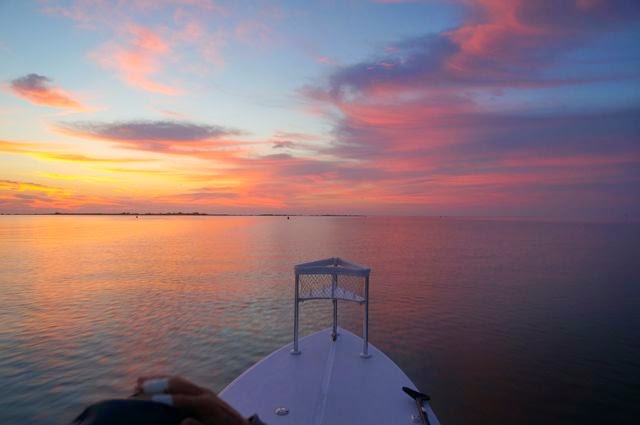
I elected not to go into my oft-favorite lagoon in favor of heading farther south in hopes of finding pods of tailing reds. I regretted my decision on the way, sure that I'd effed up and would have to backtrack later. But we shut down in an expanse of glassy foot-deep water without another boat in sight, and it was hard to fault the decision to be there. Indeed, as we poled further and further west, we began encountering small pods of reds tailing almost imperceptibly in the glassy water. We crossed a threshold that normally stops most skiffs, but the Stilt kept floating. We entered a place that rarely sees a boat. It became clear that the reds had taken refuge there, because the dark tips of their tails began appearing in the early morning light, until we were literally surrounded by pods of tailing fish. A single skiff appeared a half a mile to the east. We had it to ourselves. For about two hours, we poled from one pod to the next. The day proved to be an "adjustment" day for Howard, and only a few fish were landed.

The next day, however, we left the dock earlier in order to take advantage of the tailing action. It was twilight when we arrived at the shallow lagoon. Immediately, tails popped up all around us. For the next three hours, we enjoyed some of the best action I've seen in years. Howard landed eight reds on a light chartreuse and white Clouser, all between 24 and 26 inches.  The wind came up mid-morning, so we ran around looking for visible fish, finally returning to my favorite early morning venue. Usually, the reds leave this area by late morning, but in the fall, the water depth is sufficient enough that even during an outgoing tide, enough water remains to support feeding fish.

It was critically shallow, and I am sure we poled through water that only a Stilt could negotiate. Wow, it was full of reds feeding singly and in small roaming pods that were exploding on whatever got in their way. We poled about three hundred yards, and had about 15 good shots. Then we looped back upwind, and poled through the same area, only to have at least as many shots at big reds. Howard was really happy that he'd chosen to wait for good weather.  As we said goodbye, I urged him to return soon. He's 83, and I'm 62. I said, "come soon, because I don't know how long I will be guiding." He laughed and said, "You and I will hire a guide, then."

It's a strange feeling when I say goodbye to some of my older clients, with whom I have had such good  experiences over the past 15 years. We really don't know each other, except on the deck of a skiff. But somehow we learn most of the important things you can know about a person---how they deal with challenges, disappointments, and what role patience plays in their lives. It's a soulful exchange, much more about life than just catching fish. As Sparse Gray Hackle once said, "Sometimes I think the least important thing about fishing is catching fish."

Wednesday, October 2, 2013

Voice to text mess

I've been using the voice-to-text program Dragon dictate, and it's barely worth it, given the mess it creates. So if you find that my prose in my last post resembled the incoherent muttering of a recently awakened baboon, please forgive me. I have corrected most of it, and will endeavor to check it before publishing next time.