Getting old reminds me of my Royal Poinsiana outside my kitchen window. The tree is huge and gnarly, and looks like it can't live much longer, but each spring it explodes in new leaf and blossom. I continue to surprise myself, and give thanks each day.
I had some old flyfishing clients scheduled this past weekend, but the forecast was for unstable weather, so I warned them ahead of time. They opted to reschedule, and this time of year it's often wise to do so. The weather service usually gets it wrong.
But I thought it would be a good opportunity for Ryan and me to do some fly fishing together. I'm teaching him about the bay, and each time we go out I try to cover some new ground for his benefit. On my way down on Friday, he called and said that Scott McConal was planning to fish that evening, and that perhaps we might go out, too. I've offered to be available to Scott, too, in his guide training process, and he and Ryan have become friends. So, arriving before Ryan did, I hurriedly launched the Stilt, and had it waiting in the water when he got there at 6:00. We only had about two hours before dark, so we headed out at maximum speed, and opted for a close-in venues so we wouldn't eat up our remaining light running to more distant venues.
My research in the past several years has focused on the pattern of reds moving into shallower water just before dark to feed during the night. I like to target the shallowest areas east and west to see if the larger fish are migrating from deeper areas just before dark.
We went to one area where I've often seen oversized reds congregating just before dark. My last post concerned catching a 32" red in the same area back in May, and wondered if the mythical "spawning" size reds would be there. I once called a biologist and asked him why reds that were over 30 inches were in the lower Laguna Madre if, as he said, the reds leave the bay system forever once they become spawners. He said he didn't know, but perhaps it was to follow bait. Seemed like a weak explanation, but everyone knows that reds in the 30-35" range hang out in certain predictable areas. One of those is very close to the shallow water venue where I've seen groups of 30+" fish feeding at night. Put it together and you conclude that they stay in deeper water during the day, and then migrate into specific shallower areas at night.
We didn't find them on Friday night, but that's okay. Fish that size don't need to be following a rigid pattern if they want to stay alive. What we did find is too many giant sheepshead making way too much noise to discern anything else in the area. Ryan caught a very large sheepshead in the final minutes of daylight. We went home happy, and had dinner at Chili Willis with Scott, and made plans to fish together the next morning.
As we headed on the Arroyo Colorado, we faced thunder showers that were sweeping toward us across Padre Island. We putted along, and finally decided to go for it. Racing toward the storms, we hoped to make to the mouth of the Arroyo before they did, and then turn south. We made it, and tucked back into the southwest part of Rattlesnake Bay. We were rewarded by clearing skies as the storms played out back to the north and east.
I wanted to show the boys some of the lesser known features of Rattlesnake. We went beyond the usual boundaries of fishable water, and even had to get out of the Stilt for a while, and float it behind us as the guys waded ahead. Scott spotted an incoming redfish, barely submerged in the 7" water, and caught it handily.
Once the skies had cleared, we headed back north because I wanted to show Ryan and Scott three close-in venues that are rarely fished, that offer tremendous opportunity in the fall, when the waters are higher. We poled the first area, and determined that the fish weren't there. So we got up on plane and shut down 200 yards upwind from the other "sweet spot." Watching some terns diving over an area festooned by great egrets, we soon spotted some sweeping reds. So we staked the Stilt, and waded stealthily into the area. Sure enough, we started to see tailing and sweeping fish mixed in with an alarming number of sting rays. Fortunately, we didn't have to cover much water, since the fish were moving around aggressively. I believe we landed five reds and a big sheepshead there before the action seemed to fall off. We agreed that if we'd had sunlight, we'd caught twice as many, because whenever the sun peeped out from behind the rain clouds to the east, we'd spot reds glowing in the shallow water.
We waded back to boat and repositioned half a mile away, where I'd landed the 32" red in May. The area is not fished at all. Indeed, it's deemed too shallow by most anglers, and seems like one of those "wet but not fishable" areas. If you never wade these areas, you never challenge these assumptions. But once you take the time, and get off the boat, and explore, you often find that depth is not entirely constant, and that areas can support large fish. It's these place that constitute the true sanctuaries on the Lower Laguna. All the fish have to do is to deviate slightly from the well-traveled areas, and suddenly you have the conditions for stellar sight casting.
We poled as far as we could into the area, but the combination of shallowness and grass finally created too much friction for Ryan to pole us any further. So we got out and waded slow toward a cul de sac, beyond which was too shallow to host game fish, at least under our current tidal conditions. Last spring, during higher tides, we found the fish hundreds of yards further in, where I'd never fished in my life.
We landed three more reds, but had plenty more opportunities. The conditions were extremely sensitive, and the water depth was so minimal that the fly would usually startle the redfish on the drop. The high point was Ryan stalking a nice 25" red through a mangrove-dotted area, where he had to cast over and between mangroves in order to reach the red, whose back was out of the water.
We ended the morning with three reds apiece, and a five-pound sheepshead caught by the senior member!
The most rewarding thing about fly fishing these days is watching Ryan and Scott develop their angling and guiding skills. I had the pleasure of guiding Scott and his brother several years ago on their first fly fishing trip in saltwater, and both caught several reds. I'll never forget Scott stalking a 27" red and catching him (shown above) while his brother was whooping and hollering from 200 yards away, hooked up on his own fish.
As for Ryan, he gave up spin fishing when he was only sixteen, and has been committed to fly fishing only ever since. That's amazing. And today he has one of the finest, most unique casts I've ever seen, and a deep appreciation for Nature. I am already learning from him.
One last thing I will say about the subtle changes underway on the LLM. We have experienced a four-inch increase in water depth since the early 90s. That is a massive change. When I used to wade beyond fishable waters, either east or west, I'd reach the "algae mat," which was a dark, slick bottom that was most devoid of life. Why? Because the the areas would dry up during extreme low tides, creating the algae cover. Now, however, the algae mat begins much further, and the area that used to be covered with algae has sparse seagrass, worms and crabs thriving there. Most people would never know it, because the areas are not usually accessed by humans. But during high tides, you can imagine what happens: The fish gravitate toward these fertile new areas! And the logical times for them to visit these areas are are night and early in the morning, when the water is still cool, and the sunlight is not so bright as to blind the fish.
Yes, I know, I've said it before. But I don't think I will see you there. Because the bottom line is this: it takes the right boat, a considerable amount of faith, and a prodigious amount of energy to wade that far from your boat. All of that adds up to "you're crazy, man!"
Where Scott posts fishing reports, angling tips, essays, and lore regarding his home waters of the Lower Laguna Madre of the Gulf Coast of south Texas. His main web homes include Kingfisher Flyfishing at www.lagunamadre.net, www.dreamanalysistraining.com, and www.drscottsparrow.com
Sunday, September 15, 2019
Wednesday, May 15, 2019
A Memorable Week on the Water
My friend Paul Robilotti from Montrose, PA, came down to fish with me for the past week. He and I fish the East and West Branches of the Delaware when I'm visiting Julie's family, and he flyfishes with me down here. Two years ago, we had such incredible May fishing that I thought, "No way this will happen again." I mean we caught double digits almost every day for a week, caught well over 100 reds, and made one of the best videos I've ever captured.
When I saw that the weather was supposed to be poor, I encouraged him to reschedule if he could. Rain and wind were forecasted for just about every day for the week of his visit. But Paul said he'd prefer to take whatever nature dealt us. So he arrived last week on Tuesday night. Wednesday, after my final department meeting, we took off with my dog Rosie for our trailer at Channelview RV Park in Arroyo City, armed with plenty of gas and freshly tied flies.
That afternoon, we went out hoping for birding. We found extremely high water levels associated with hurricane tides. What was up? Well, we had a new moon, which creates high tides each month, and especially high tides in the spring and fall. But they tides were beyond our usual seasonal highs. For some time now, we have seen not-so-subtle changes on the LLM. Grass is covering the east side, black mangroves line every shoreline, and fish have changed their feeding patterns. Much of this is due to warm winters, and hotter summers. The warm winters have fostered plant growth, and the hot summers have driven the fish off the flats during midday, and encouraged nighttime feeding. I have written extensively about the shift of feeding activity to the evening hours, but I wasn't sure we were going to find that pattern happening so soon in the season. But we did.
We did poorly that evening, and the next day, too, with Paul landing a single red that was in a pod under some birds. The birding was "on" during the afternoon, but the water levels were so high that nothing could be seen beneath the hovering and dipping gulls. Once you waded up to them, and they peeled off, nothing was left to cast to. It was a bit disheartening to find the only action of the day so void of targets.
Chip joined us on Friday, and we did better. We found birds early, and the winds were tolerable. We only landed two reds, but we found visible tailing fish under birds. Later we found a few tailing reds down south, but caught none.
We took the day off on Saturday, since Paul had an orthodontics appt. in Mexico, and I had to attend graduation in McAllen.

On Sunday, Chip and Ryan joined us for what turned out to be our best day thus far. We landed six reds in the morning, three under birds, and three that were tailing in clear water. I saw birds working in "impossibly shallow" water, and despite my rational assessment that nothing could actually be there, I hiked half a mile further into what, from the distance, looked like dry land. It was a site to see--reds feeding aggressively and then disappearing in five inches of water. It's amazing how they can hunt in almost no water, and move about almost imperceptibly. I caught one of them, and called Ryan to join me. Alas, we were fishing upwind, and the action was spread out. At about 1:00, we decided to go in, because it was Mother's Day and Chip had to be home, and Ryan needed to get some rest before his work week. Paul and I napped for a while, then headed out for some hoped-for evening action.
It was the highpoint of the week. I had decided not to fish, but to handle the boat and provide support for Paul. We were thinking that it was the last time we'd have on the water, since the forecast called for 80% rain the next morning.

We immediately found tailing reds under birds. Paul caught two reds and a 21" trout before we saw birds working, once again, far beyond the usual margins of habitable water. So we took the boat as far as we could, and waded three hundred yards further toward a mass of birds working over reds in "spit." Alas, they broke up and shot upwind of us. Dragging ass back to the boat, we considered fishing a different area, where the fish may have headed. I took the Stilt over there, and shut down as we saw a few birds working near a shoreline.
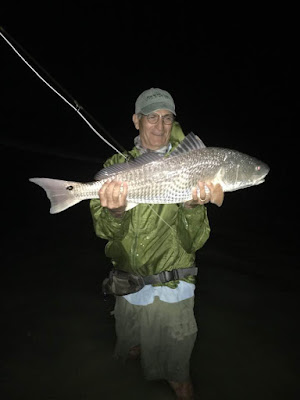
Paul waded directly to the birds, but found casting to be difficult in grass-filled water. Eventually, I ambled toward him, and saw some activity another 200 years further, so...though tired, I decided to check it out. As I got close, I could see that reds were all over, pushing water and attacking bait as birds tried to stay aloft in the dying wind. Groups of five or six obviously large fish were feeding in the area. I started casting, and could not get their attention. Or I would spook them. I was becoming frustrated, and then I thought, "Settle down and stop aggressing on the fish. Make a gentle cast." I switched to a size 8 Mother's Day fly--a tiny fly for the conditions, but one that I could case unobtrusively--and made a couple of short casts to what appeared to be a large red that had stopped its sweeping action, and was swimming slowly by me. Suddenly, it took my fly and made a run that almost took my arm off. Fortunately, the leader held. For the next 45 minutes, I fought a fish that I never really turned until the last 3-4 minutes. It was so strong that I found myself simply holding my rod against an immovable force that wouldn't budge until, suddenly, it would shake its head to let me know it was still alive. I was using my 6-wt TFO Axiom II, and my TFO Power reel, which were up to the task. But I never felt that I was in control, even when I reached down, thirty minutes after sundown and felt for the fish's tail in the dark. It was eery grasping at the tail of a 32", 17 lb red. Paul had been wading close by in case I needed help, and when I lifted the fish out of the water, with difficulty, Paul said, "Oh my God, that's a huge fish!" I walked over and said, "I want you to feel this fish." He took it and couldn't hold to the slippery monster. It fell back into the water, caught its second wind, and it was another five minutes before I held him. We carried him to the boat to measure him, and were able to determine its length by adding the six-inch span between my thumb and pointing finger to the 26" ruler that was on the deck. 32" and 17 lb. estimated. Paul took this picture with his Iphone before we released the fish. When I got the Stilt up on plane, and reached to turn on the running lights, they were out! So we had to run the 8 miles home without running lights. Fortunately, one of my favorite old clients had gifted me with a powerful LED flashlight that guided our way out of the back lagoon, and down the Arroyo to our slip at Channelview Park. We were so beat from the day! We at dinner at 10 pm and crashed heavily into sleep. A great end to a memorable week with Paul, my brother Chip, and son Ryan. The weather was bad, but we found the fish. As Eric Glass once said, Anyone can catch fish on a good day.
When I saw that the weather was supposed to be poor, I encouraged him to reschedule if he could. Rain and wind were forecasted for just about every day for the week of his visit. But Paul said he'd prefer to take whatever nature dealt us. So he arrived last week on Tuesday night. Wednesday, after my final department meeting, we took off with my dog Rosie for our trailer at Channelview RV Park in Arroyo City, armed with plenty of gas and freshly tied flies.
That afternoon, we went out hoping for birding. We found extremely high water levels associated with hurricane tides. What was up? Well, we had a new moon, which creates high tides each month, and especially high tides in the spring and fall. But they tides were beyond our usual seasonal highs. For some time now, we have seen not-so-subtle changes on the LLM. Grass is covering the east side, black mangroves line every shoreline, and fish have changed their feeding patterns. Much of this is due to warm winters, and hotter summers. The warm winters have fostered plant growth, and the hot summers have driven the fish off the flats during midday, and encouraged nighttime feeding. I have written extensively about the shift of feeding activity to the evening hours, but I wasn't sure we were going to find that pattern happening so soon in the season. But we did.
We did poorly that evening, and the next day, too, with Paul landing a single red that was in a pod under some birds. The birding was "on" during the afternoon, but the water levels were so high that nothing could be seen beneath the hovering and dipping gulls. Once you waded up to them, and they peeled off, nothing was left to cast to. It was a bit disheartening to find the only action of the day so void of targets.
Chip joined us on Friday, and we did better. We found birds early, and the winds were tolerable. We only landed two reds, but we found visible tailing fish under birds. Later we found a few tailing reds down south, but caught none.
We took the day off on Saturday, since Paul had an orthodontics appt. in Mexico, and I had to attend graduation in McAllen.
On Sunday, Chip and Ryan joined us for what turned out to be our best day thus far. We landed six reds in the morning, three under birds, and three that were tailing in clear water. I saw birds working in "impossibly shallow" water, and despite my rational assessment that nothing could actually be there, I hiked half a mile further into what, from the distance, looked like dry land. It was a site to see--reds feeding aggressively and then disappearing in five inches of water. It's amazing how they can hunt in almost no water, and move about almost imperceptibly. I caught one of them, and called Ryan to join me. Alas, we were fishing upwind, and the action was spread out. At about 1:00, we decided to go in, because it was Mother's Day and Chip had to be home, and Ryan needed to get some rest before his work week. Paul and I napped for a while, then headed out for some hoped-for evening action.
It was the highpoint of the week. I had decided not to fish, but to handle the boat and provide support for Paul. We were thinking that it was the last time we'd have on the water, since the forecast called for 80% rain the next morning.
We immediately found tailing reds under birds. Paul caught two reds and a 21" trout before we saw birds working, once again, far beyond the usual margins of habitable water. So we took the boat as far as we could, and waded three hundred yards further toward a mass of birds working over reds in "spit." Alas, they broke up and shot upwind of us. Dragging ass back to the boat, we considered fishing a different area, where the fish may have headed. I took the Stilt over there, and shut down as we saw a few birds working near a shoreline.
![]() |
| The largest red I've caught in years -- 33" |
Tuesday, April 2, 2019
New Youtube Video
I thought you would like to see this video I made with Ted Rufner, a guide and veteran fly fishing from the Gulf Coast of Florida. Ted knew reds, but this was his first hike to the LLM. Enjoy!
https://www.youtube.com/watch?v=3vCXwHhMgtw&feature=youtu.be
Saturday, December 29, 2018
New Season Approaching
Some of our old clients, in particular, are stirring from their winter slumber and calling us for some 2019 fly fishing. A while ago, my old client Tony Woodward (and his buddy Scott Minnich) called after they'd been fishing the Arkansas River in CO in 28 degrees. Not surprisingly, the topic of fly fishing the Lower Laguna, where it's rarely below 60 degrees during our regular season, came up. So they called to make plans. Indeed, it's a good time to plan ahead, given the demand for April and May, in particular. For the past three years, the spring has been the best fly fishing for me, offering altogether new phenomena on the east and west sides. Again, we plan to offer late fishing options, of your schedule will allow it. Consider coming in early if you can and starting your fishing at sundown.
Ryan and I will be fishing a lot as the weather improves. We went out recently with a friend of his, who didn't think he needed lightweight waders since the air temperature was in the 70s. But this time of year, it can be surprising to find how the water temperature, which can be in the low 60s can cool the air by 8 degrees. Add to that the chill factor of running at 35 mph, and hypothermia is a real possibility.
This year, I will be working with Ryan whenever possible to teach him to guide, as well as to offer single clients double coverage during the day. Usually, a single guide moves more slowly than two, since he has to make round trips to the boat, if wading. A second guide, however, can wade back and get the boat while the other guide assists the client in seeing and casting to fish. Of course, this arrangement is optional, and always up to the client's preference.
We expect to be exploiting the same east side action in April and May that we've enjoyed the past two years, as well as targeting the four or five regular hotspots on the west side. Last year, I used VIP poppers more than in recent years--going back to my roots of preferring topwater whenever the conditions will allow, or warrant it. There's nothing like a big red or trout pushing water behind a popper!
Randy and I are putting our heads together and hoping to plan some group weekends, where you can elect to come down alone or with a partner, and pay one price for lodging, guiding and meals. Stay tuned, or if you're interested in the mean time. give us a holler.
I hope to have some new pics soon.
Ryan and I will be fishing a lot as the weather improves. We went out recently with a friend of his, who didn't think he needed lightweight waders since the air temperature was in the 70s. But this time of year, it can be surprising to find how the water temperature, which can be in the low 60s can cool the air by 8 degrees. Add to that the chill factor of running at 35 mph, and hypothermia is a real possibility.
This year, I will be working with Ryan whenever possible to teach him to guide, as well as to offer single clients double coverage during the day. Usually, a single guide moves more slowly than two, since he has to make round trips to the boat, if wading. A second guide, however, can wade back and get the boat while the other guide assists the client in seeing and casting to fish. Of course, this arrangement is optional, and always up to the client's preference.
We expect to be exploiting the same east side action in April and May that we've enjoyed the past two years, as well as targeting the four or five regular hotspots on the west side. Last year, I used VIP poppers more than in recent years--going back to my roots of preferring topwater whenever the conditions will allow, or warrant it. There's nothing like a big red or trout pushing water behind a popper!
Randy and I are putting our heads together and hoping to plan some group weekends, where you can elect to come down alone or with a partner, and pay one price for lodging, guiding and meals. Stay tuned, or if you're interested in the mean time. give us a holler.
I hope to have some new pics soon.
Sunday, June 10, 2018
June Update
I haven't had much time to blog, given my summer school and private practice commitments. But I have had some great days on the water with old and new clients.
We started, as usual, on the sand and found tailing reds spread out in all directions. Mike was able to stalk several there, before finally hooking and landing his first red on a fly. Once the sun rises, the reds leave the sand and head west. After a couple of hours of stalking single snd pairs, we were left with only sheepshead punctuating the glassy surface. So we left and headed to parts unknown until entering a birding venue at midday. It was a long shot that we would find pods working under birds at 1 pm, but I'm never surprised by what the Lower Laguna offers up. Indeed, we found large pods of 30-50 fish feeding vigorously in 12 inches of water. By that time of day, most of the anglers have left the grassy west-side lagoons, so we had it to ourselves. Mike managed to land three more reds before heading in.
This past weekend, I had the privilege of guiding an old client, Dr. Dan Casso and three of his friends. Truett Cawlfield worked with me to provide the guiding for the two days. Truett is a gifted angler, and has a great future as a Laguna Madre guide. It was pleasure working with him.
It was tough fishing. The early action on the sand was remarkable on both weekend days, but after that, it was difficult to find catchable fish. It's been turning off earlier than it used to, so I've taken to encouraging my clients to go in earlier than usual, and then go back out around 6 pm. The four guys opted to do that at the end of the first day. I headed as far east as my Stilt could go without needing to be pushed out into the deeper water. Alas, the redfish action was not "on," so we went to a west-side venue known for its large reds feeding just before sundown.
When we entered the lagoon, the gulls were already working in a frenzy, and we could see sweeping groups of large reds circling
the area, driving bait into the air. Unfortunately, the guys didn't hooks up on one of these oft-oversized reds.
When I woke up this am, I realized that today was going to be especially challenging, given the wind predictions above 25 mph. We went into water on the east side that was glassy, even in the wind. The guys had shots at tailing pairs of redfish, but were unable to hook up. Then we headed north to the East Cut, and they opted to wade over the oysters on the north side so they could fish largely untouched water.
It was eerie at sunrise. Glassy water as far as we could see beyond the place I'd shut down. It was perfect conditions; but unfortunately, the number of redfish showing didn't provide enough targets to make it worth our while. So we headed north and entered the east cut before committing to a wade beyond the oysters on the north side of the cut. The treacherous wade across the oyster barrier was enough to make me worry about my liability; but the guys were able to negotiate the oysters and emerge on the north side where we found some tailing reds. One of my clients caught a red before I headed back to get the boat. Meanwhile, the guys spotted a huge redfish, or so they said, and couldn't get the fish to take their flies. I suggested that it was a black drum, but Mark insisted that it was a red because it had a spot on its tail.
The wind turned form windy to fierce about midday, and the flats were devoid of life. Running south from the East Cut after fishing there for a while, I realized that the best opportunities were behind us. So I circled back to the Cut where I suggested we fish the little channels that cut into the flats on the north side of the channel. Choosing one that we hadn't fished yet, I anchored the Stilt and encouraged Tom and Mark to fish the inlets for reds and giant drum. As it turned out, the inlet I'd chosen was full of black drum from 15-45 pounds. After casting a few times, Mark hooked up on the biggest fish he'd ever caught on a fly rod. We figured it was 40 pounds. After a few photos, he released it and we soon headed south again, back to the Arroyo.
More and more, I'm offering my clients to split the day into two halves. We come in midday, nap, and then go out in the evening. Whether this divided action is due to hotter temperatures or something else, I am convinced that the Lower Laguna Madre is fishing differently than it used to. The summer afternoon action on the sand seems a thing of the past. But the sunset drama is worth the tradeoff.
About a month ago. Mike Romano from Houston came down and fished with me. He'd never caught a redfish on the fly, and he was able to catch his first four reds with me.
This past weekend, I had the privilege of guiding an old client, Dr. Dan Casso and three of his friends. Truett Cawlfield worked with me to provide the guiding for the two days. Truett is a gifted angler, and has a great future as a Laguna Madre guide. It was pleasure working with him.
It was tough fishing. The early action on the sand was remarkable on both weekend days, but after that, it was difficult to find catchable fish. It's been turning off earlier than it used to, so I've taken to encouraging my clients to go in earlier than usual, and then go back out around 6 pm. The four guys opted to do that at the end of the first day. I headed as far east as my Stilt could go without needing to be pushed out into the deeper water. Alas, the redfish action was not "on," so we went to a west-side venue known for its large reds feeding just before sundown.
When we entered the lagoon, the gulls were already working in a frenzy, and we could see sweeping groups of large reds circling
the area, driving bait into the air. Unfortunately, the guys didn't hooks up on one of these oft-oversized reds.
Okay, so what the skinny? Fishing early on the sand had been reliably good, but it falls off after a couple of hours. Then the sand is devoid of life, and a guide runs around looking for miracles. There are some fish to be found, such along the Intracoastal spoil banks, but they are few and far between. I have been convinced that that best action is early and just before dark, and have found this assessment to be almost 100% reliable.
When I woke up this am, I realized that today was going to be especially challenging, given the wind predictions above 25 mph. We went into water on the east side that was glassy, even in the wind. The guys had shots at tailing pairs of redfish, but were unable to hook up. Then we headed north to the East Cut, and they opted to wade over the oysters on the north side so they could fish largely untouched water.
It was eerie at sunrise. Glassy water as far as we could see beyond the place I'd shut down. It was perfect conditions; but unfortunately, the number of redfish showing didn't provide enough targets to make it worth our while. So we headed north and entered the east cut before committing to a wade beyond the oysters on the north side of the cut. The treacherous wade across the oyster barrier was enough to make me worry about my liability; but the guys were able to negotiate the oysters and emerge on the north side where we found some tailing reds. One of my clients caught a red before I headed back to get the boat. Meanwhile, the guys spotted a huge redfish, or so they said, and couldn't get the fish to take their flies. I suggested that it was a black drum, but Mark insisted that it was a red because it had a spot on its tail.
The wind turned form windy to fierce about midday, and the flats were devoid of life. Running south from the East Cut after fishing there for a while, I realized that the best opportunities were behind us. So I circled back to the Cut where I suggested we fish the little channels that cut into the flats on the north side of the channel. Choosing one that we hadn't fished yet, I anchored the Stilt and encouraged Tom and Mark to fish the inlets for reds and giant drum. As it turned out, the inlet I'd chosen was full of black drum from 15-45 pounds. After casting a few times, Mark hooked up on the biggest fish he'd ever caught on a fly rod. We figured it was 40 pounds. After a few photos, he released it and we soon headed south again, back to the Arroyo.
More and more, I'm offering my clients to split the day into two halves. We come in midday, nap, and then go out in the evening. Whether this divided action is due to hotter temperatures or something else, I am convinced that the Lower Laguna Madre is fishing differently than it used to. The summer afternoon action on the sand seems a thing of the past. But the sunset drama is worth the tradeoff.
Monday, May 28, 2018
Fish Tales
I guided an old friend and legendary flyfisher Joe Averill, and his son Trey, yesterday, and I took them out for fun the evening before with my brother Chip. We went far east, hoping for the phenomenon I discovered two years ago--reds pouring into the super shallow sand before sundown. Alas, it wasn't great like it was the evening before, when my buddy Bobboy McConal and his sons Scott and Sean had a stellar evening in the same area. Nonetheless, we landed four before coming in. After running a favorite west side venue at daybreak, finding little to entice me, I headed back to the same general area and shut down in about 10 inches of water. I laid out the plan--Walk east until we find the fish. It's quite counter intuitive, because it gets almost prohibitively shallow--about 5 inches--and all you see is sheepshead. It's temping to turn around. But on faith and experience, I kept the guys heading further through a dead zone until the water deepened again, and...tails sprouted ahead of us. We proceeded to cast to pods for the next two hours. Joe landed a bunch before the pods started to sweep around and head west. After a while, it was only sheepshead again. But it was a great morning, and as it turned out, it was the best we found.
Warning: Don't try to take your boat where you think we're fishing. One guy did just that yesterday am in a boat that was not equipped to go shallow, much less in 6 inches of water. He and his friends were 1/2 mile north of us, and they spent hours pushing their boat back to deeper water. Stop and wade, unless you have a Stilt or the equivalent. Or you'll regret the adventure.
More later. Got to do some counseling!
Warning: Don't try to take your boat where you think we're fishing. One guy did just that yesterday am in a boat that was not equipped to go shallow, much less in 6 inches of water. He and his friends were 1/2 mile north of us, and they spent hours pushing their boat back to deeper water. Stop and wade, unless you have a Stilt or the equivalent. Or you'll regret the adventure.
More later. Got to do some counseling!
Monday, May 7, 2018
Learning New Things Takes Risks
This past weekend, I enjoyed the best of the "new" patterns. I fish just before dark on Saturday night in an area which hosts oversized redfish at night, and caught two in the 27-28" range, and missed the cast on the dozen others that were streaming into bootie deep water as the sun touched the western horizon. The two weekends before had reaped 29-30+" reds on two consecutive outings, underscoring the robustness of this pattern. There are several westside venues where this is happening, so pick your favorite spot and check it out.
But not before we'd landed four reds and hooked a couple of more. In water that no one, not anyone fishes. It's too shallow to pole, and like I said, there's nothing for hundreds of yards. If you can walk that far on faith alone (in what I've told you), you'll probably be grateful. But not many of you will, which is also fine with me :-)
Photos to follow.
Monday, April 30, 2018
Oversized Reds
Yesterday, I hosted Don Puckett from Katy Texas, who came down to video me while I tied the VIP Popper and Mother's Day Fly. I will be posting the Vimeo links just as soon as he edits the video.
Don arrived around noon, so we proceeded to do the video, and then took off for some evening flyfishing. I took Don directly to the venue where I'd caught a 30-inch red last Saturday, and could have caught several more. We entered the area much earlier than the previous week--about 3:00 instead of 4:30. I fully expected to take a look, and find nothing, in which I would go elsewhere for a couple of hours and then return for the hoped-for evening action. But we hadn't gone far before I saw single gulls working close to the water, signifying feeding redfish. So I staked the Stilt inconveniently downwind of the action, and we proceeded to wade upwind to the working birds. It wasn't long before some of the reds that were sweeping around headed our way. Casting a red VIP to three or four wakes that were clearly visible under a single gull, one of the fish grabbed the fly and shot off. It didn't take me long to realize that the fish was at least 30 inches long, perhaps as much as 32 inches. It created quite a commotion blowing up and ripping through the shallow water. I had fought him for about five minutes, and he really hadn't turned yet. Fortunately, he stayed in the area, and then unfortunately he headed straight for me while he was still clearly "green" and far from ready to come to the hand. I waved my free arm, and kicked the water with my booties, hoping the fish would turn, but alas he sped up and shot a foot past my right leg. The line whipped under my arm, and pow! The tippet parted at the blood knot connection!

I replaced my fly with a Mother's Day fly, and turned back to the fish that were sweeping upwind. Within a few minutes, another pair of big reds swam by me about 40 feet crosswind. I managed to get the MDF to the lead fish, which came out of the water and hit it explosively. I landed that fish, and it was 28-29 inches. Don and I did not land any more fish, but we both had several more shots. The conditions were difficult--windy and casting upwind, murky water, and oversized, wary fish. It was easy to blow them up or miss the cast. Nonetheless, it was a spectacle we'll never forget. Don was happy just to see the number of large reds in such shallow conditions.
Don arrived around noon, so we proceeded to do the video, and then took off for some evening flyfishing. I took Don directly to the venue where I'd caught a 30-inch red last Saturday, and could have caught several more. We entered the area much earlier than the previous week--about 3:00 instead of 4:30. I fully expected to take a look, and find nothing, in which I would go elsewhere for a couple of hours and then return for the hoped-for evening action. But we hadn't gone far before I saw single gulls working close to the water, signifying feeding redfish. So I staked the Stilt inconveniently downwind of the action, and we proceeded to wade upwind to the working birds. It wasn't long before some of the reds that were sweeping around headed our way. Casting a red VIP to three or four wakes that were clearly visible under a single gull, one of the fish grabbed the fly and shot off. It didn't take me long to realize that the fish was at least 30 inches long, perhaps as much as 32 inches. It created quite a commotion blowing up and ripping through the shallow water. I had fought him for about five minutes, and he really hadn't turned yet. Fortunately, he stayed in the area, and then unfortunately he headed straight for me while he was still clearly "green" and far from ready to come to the hand. I waved my free arm, and kicked the water with my booties, hoping the fish would turn, but alas he sped up and shot a foot past my right leg. The line whipped under my arm, and pow! The tippet parted at the blood knot connection!

I replaced my fly with a Mother's Day fly, and turned back to the fish that were sweeping upwind. Within a few minutes, another pair of big reds swam by me about 40 feet crosswind. I managed to get the MDF to the lead fish, which came out of the water and hit it explosively. I landed that fish, and it was 28-29 inches. Don and I did not land any more fish, but we both had several more shots. The conditions were difficult--windy and casting upwind, murky water, and oversized, wary fish. It was easy to blow them up or miss the cast. Nonetheless, it was a spectacle we'll never forget. Don was happy just to see the number of large reds in such shallow conditions.
Thursday, April 26, 2018
The Very Best Action is Before Sundown
It was a windy Saturday, and my partner Randy had had his trip canceled because his clients were afraid of the wind. Rosie and I went out about 4:30 to do one of our favorite things, which is to fish on the sand, and/or in one of our favorite westside lagoons. I ducked into the lagoon since it was on the way more or less, and I saw some single gulls working in very shallow water. So Rosie and I got out of the boat and walked over close to where the birds were tracking up wind, obviously following single reds or small groups in about 7 inches of water. Even though the wind was blowing 25 miles an hour, and the water was completely muddy, I knew I could see them coming upwind. The problem is always getting the fly close enough to where they can see it, but far enough away from them to where they don’t spook--almost an impossible compromise, but the fish are incredibly sensitive in this condition, and will sometimes sense the fly from three feet away. The reds coming in to this area late in the evening, tend to be very large, often oversized. So they are wary, and especially smart. I had shots at probably eight or 10 fish, some of which would appear 80 or 90 yards out under a single bird, giving me a chance to get into place for the cast. But between the wind being so strong, and the fish so wary, I blew up every opportunity. In addition to seeing the fish coming upwind under a bird or two, I would occasionally see a back out the water 10 or 15 feet away from me, cruising by. It was very hard to cast to these fish that were so close to us. But I didn’t get frustrated, because I’ve caught so many reds in the past, I don't need much to satisfy me: I just enjoy being out there. So after while, I decided to head toward the Eastside and check out the sand, where the reds often pour into the shallowest water before sunset. But after getting up, and before I had left the westside lagoon, I saw some birds working along another shoreline, so I ran over and stopped, and got out and walked over to where the birds were frenetically working over fish. Before I could get to the place with the birds were working, I saw a single huge redfish working toward me up the shoreline with his back out of the water, zigging and zagging as the baitfish flared in his path.

I was getting ready to make a cast in a very difficult scenario, in which there was about an 80% chance that the fish would spook when the fly hit the water, when I saw a single bird working upwind to my left about 50 yards. I could see some dark tails coming out of the muddy water moving upwind, so I decided to make a cast to those fish before heading back to stalk the big red on the shoreline. I fully expected the group of fish to be smaller, but perhaps more eager, so I made a long backhand crosswind cast just to the head of the group--a cast that I couldn't have made 10 years ago. I hooked up on a red that shot away so fast that I almost lost my grip on my rod. The powerful fish turned out to be a 30-inch redfish that almost spooled me before I finally turned him. It was a long fight, and after landing him I took a couple pictures of the fish on the shoreline before releasing him. Satisfied with my success, I walked back to the boat with Rosie and prepared to leave for home, when I noticed that the west side of the lagoon was festooned with laughing gulls dipping to the water and clearly working over fish in water that was no deeper than six inches. In the past, I have encountered this scenario on many occasions, in which a large cohort of oversize redfish come into this particular area at dusk, and leave before morning. Almost no one knows about this phenomenon. I have a friend who fishes just a few hundred yards from the mouth of this lagoon and catches oversize reds regularly in deep water on bait and Gulps. We’ve often wondered where the fish went to feed, but I think I know now, because on many occasions, I found groups of 27-32 inch reds cruising into this area right before sundown (see earlier posts). Anyway, Rosie and I took the boat over close to where the fish were feeding, and watched the birds and crashing fish for a while before deciding that I didn’t need to catch another oversize redfish to be happy. So Rosie and I headed home and got back to the dock well before the sunset.
Once again, no one was there with us to see the action, and it’s pretty hard to believe it when you hear me tell the story. But I assure you, it’s one of the most durable phenomena on the bay at this time, and is the very best action I’ve encountered in years. I went back the next morning with my brother and son, and the reds were completely gone. So unless you go late in the day, you would never know that the area is regularly populated with oversized redfish just 12 hours before the usual "best time," that is, at daybreak. Fortunately not many guys stay out late in the day, and there’s not many people can access such shallow water without a $50,000 boat. So I don’t mind telling you about this. If you’ve got what it takes, please feel free to join me! That is, if you know exactly where I’m going. Close won't do it.

I was getting ready to make a cast in a very difficult scenario, in which there was about an 80% chance that the fish would spook when the fly hit the water, when I saw a single bird working upwind to my left about 50 yards. I could see some dark tails coming out of the muddy water moving upwind, so I decided to make a cast to those fish before heading back to stalk the big red on the shoreline. I fully expected the group of fish to be smaller, but perhaps more eager, so I made a long backhand crosswind cast just to the head of the group--a cast that I couldn't have made 10 years ago. I hooked up on a red that shot away so fast that I almost lost my grip on my rod. The powerful fish turned out to be a 30-inch redfish that almost spooled me before I finally turned him. It was a long fight, and after landing him I took a couple pictures of the fish on the shoreline before releasing him. Satisfied with my success, I walked back to the boat with Rosie and prepared to leave for home, when I noticed that the west side of the lagoon was festooned with laughing gulls dipping to the water and clearly working over fish in water that was no deeper than six inches. In the past, I have encountered this scenario on many occasions, in which a large cohort of oversize redfish come into this particular area at dusk, and leave before morning. Almost no one knows about this phenomenon. I have a friend who fishes just a few hundred yards from the mouth of this lagoon and catches oversize reds regularly in deep water on bait and Gulps. We’ve often wondered where the fish went to feed, but I think I know now, because on many occasions, I found groups of 27-32 inch reds cruising into this area right before sundown (see earlier posts). Anyway, Rosie and I took the boat over close to where the fish were feeding, and watched the birds and crashing fish for a while before deciding that I didn’t need to catch another oversize redfish to be happy. So Rosie and I headed home and got back to the dock well before the sunset.
Once again, no one was there with us to see the action, and it’s pretty hard to believe it when you hear me tell the story. But I assure you, it’s one of the most durable phenomena on the bay at this time, and is the very best action I’ve encountered in years. I went back the next morning with my brother and son, and the reds were completely gone. So unless you go late in the day, you would never know that the area is regularly populated with oversized redfish just 12 hours before the usual "best time," that is, at daybreak. Fortunately not many guys stay out late in the day, and there’s not many people can access such shallow water without a $50,000 boat. So I don’t mind telling you about this. If you’ve got what it takes, please feel free to join me! That is, if you know exactly where I’m going. Close won't do it.
Sunday, April 1, 2018
Casual to a Fault
Rosie and I went wading for a few minutes, and located a couple of reds that were feeding in about six inches of water, with backs breaking the surface. My unpracticed cast was less than perfect, and the reds fled to deeper water. I didn't care, because catching fish wasn't my goal. I headed back to the boat and joined our guests, who were eating all kinds of delectable finger foods on the front deck of the Stilt, and sipping drinks in the low, dramatic sunlight.
We headed in before the sun actually set, and tugged on Swisher Sweets and Cuban cigars for a while before Alex and Bethany headed back to Reynosa, where Alex works as an orthodontist.
The next morning Julie, Rosie and I left the dock before sunrise. For all of the times Julie and I had been out on the bay together, we'd never gone out at daybreak together. We headed for a place I often go at daybreak to see if the reds are gathered and tailing beneath gulls and terns. The breeze was low enough to see tails if the fish were inclined to pod up. We ran into the shallowest areas of the lagoon, and shut down when I saw gulls and terns diving and hovering above the water ahead of us. Then I realized that not only had I left the push pole back at the trailer (on purpose), I'd forgotten my booties, as well (not on purpose). So my goals were necessarily limited due to my casual preparation. A week before, I'd been similarly non vigilant, and had forgotten to bring extra gas for the boat. These are early spring phenomena; that is, I often mess up before I get my equipment in place, and my honed-in guide mentality up and running.
But I wasn't going to be deterred from casting to the giant red that I immediately spotted heading our way, about 200 yards north of us. I had just enough time to remove my rod from the holder, slip into the water, and wade through the yucky mud far enough from the boat not to catch the poling platform or Julie with my back cast. Armed with a size 8 Clouser, I thought, "What are the chances the red will perceive this fly in this off-colored water?" Then again, I recalled many occasions when I'd been in the same lagoon on windy days, when fast-cruising reds would perceive the fly when it was fully five feet away in rough water. Sure enough, when the wake approached, and I put the tiny fly about three feet to the front of the red, it shot forward and took the fly. Since my line was slack, and the red was barreling down on me, I couldn't get a good hookup. Finally I got tight to the fly, and the red--probably 30 inches in length--porpoised in the 8-inch water, and showed me most of his huge body before plowing by me and throwing the fly.
I don't need much more than that to be happy, so I stood in one spot for a while and made a few casts at nervous water before wading back to the boat.
We spent a while watching the birds working over the feeding reds, and then headed east for a boat ride. Julie was so happy to see the Laguna Madre at dawn, and wants to go out with me before sunrise more often. That was the biggest "catch" of the day.
I know you want something more than casual fishing stories. More serious tales will soon follow, because I can assure you that the Laguna Madre is going to fish very well this year. All of the signs are in place: low algae on the west side, a comparatively cold and wet winter, and several "turned on" days on the east side already documented by the usual suspects. You should consider coming down.
Thursday, March 15, 2018
Rekindling Desire
Ryan and went out together last Saturday, and poked into Parker Lake to see if the reds were gathering there, yet. Sure enough, we passed a small school on our way in, but we headed past them, back to the southwest shoreline, where few boats ever go. We could tell that the fish were there, but our hearts were elsewhere; so after registering the fact that Parker Lake was "on," we left and headed north toward the East Cut. Running about 9 miles north of the mouth of the Arroyo, we skimmed across the shallowest and most remote portions of the Lower Laguna, where boats rarely go because it's not on the way to anywhere.
We had gone out after the sun had risen, because Ryan had awakened with an upset stomach. I'd waited by the boat, watching the fog roll in and then lift above the Arroyo, giving us a clear view of the water ahead. It was fortunate, in one sense, that Ryan had arrived so late. For not only did it save us from the impulse to run in the fog but it gave the sun time to burn off the low clouds until the day finally became cloudless.
We stayed in one area for the rest of the day. The tide was very high, a spring tide that had pushed water way above the shelf. Normally, we fish in 6-9 inches of water, but the cloudless sky enabled us to fish in slightly deeper water than usual. Since we saw big trout and reds running, we came off of plane, staked the Stilt, and proceeded to wade northward, with the sun at our backs.
Rosie was with us, and she didn't hesitate to jump off the stern and join me on the first of three long wades. Ryan and I agreed later that we never lost our focus--that there were enough fish to keep us attentive and eager.
The reds were very sensitive, as they often are in March and April. I'm not sure why, but it's typical for reds to spook so far out that even the best casters cannot reach them before they turn. They weren't that spooky, but they were very sensitive to the fly, and often reacted to a near-perfect presentation. And then, when they chased the fly, they often nipped at it, or turned off before taking it. It was challenging, to say the least.
But the highlight of the day were the large trout cruising on the sand. I had three shots at 24+" trout. I missed one, lost one, and landed one--which is about as good as it gets. In contrast to the reds, the trout were especially aggressive. Indeed, when I saw the one I caught approaching me, I casted to her and the fly landed about 6 feet from her. Thinking that she wouldn't see it, I lifted my rod to make my back cast, only to see her rush forward after the fly as it left the water. I casted the fly again, and this time it landed about a foot ahead of the frustrated fish. She came to the surface and exploded audibly on the fly. A few minutes later, I released her after getting a couple of photos.
The big trout are typically on the sand until about mid-May when they begin to spawn. At that point, they gravitate toward the grassy areas nearer deeper water, and spawn once a week or so until the end of the summer. The spring is a special time for seeing big trout on the sand. It takes a lot of skill, and even more luck, to entice one of these consummate predators. They are in a category by themselves. Good luck in your quest.
We had gone out after the sun had risen, because Ryan had awakened with an upset stomach. I'd waited by the boat, watching the fog roll in and then lift above the Arroyo, giving us a clear view of the water ahead. It was fortunate, in one sense, that Ryan had arrived so late. For not only did it save us from the impulse to run in the fog but it gave the sun time to burn off the low clouds until the day finally became cloudless.
We stayed in one area for the rest of the day. The tide was very high, a spring tide that had pushed water way above the shelf. Normally, we fish in 6-9 inches of water, but the cloudless sky enabled us to fish in slightly deeper water than usual. Since we saw big trout and reds running, we came off of plane, staked the Stilt, and proceeded to wade northward, with the sun at our backs.
Rosie was with us, and she didn't hesitate to jump off the stern and join me on the first of three long wades. Ryan and I agreed later that we never lost our focus--that there were enough fish to keep us attentive and eager.
The reds were very sensitive, as they often are in March and April. I'm not sure why, but it's typical for reds to spook so far out that even the best casters cannot reach them before they turn. They weren't that spooky, but they were very sensitive to the fly, and often reacted to a near-perfect presentation. And then, when they chased the fly, they often nipped at it, or turned off before taking it. It was challenging, to say the least.
But the highlight of the day were the large trout cruising on the sand. I had three shots at 24+" trout. I missed one, lost one, and landed one--which is about as good as it gets. In contrast to the reds, the trout were especially aggressive. Indeed, when I saw the one I caught approaching me, I casted to her and the fly landed about 6 feet from her. Thinking that she wouldn't see it, I lifted my rod to make my back cast, only to see her rush forward after the fly as it left the water. I casted the fly again, and this time it landed about a foot ahead of the frustrated fish. She came to the surface and exploded audibly on the fly. A few minutes later, I released her after getting a couple of photos.
The big trout are typically on the sand until about mid-May when they begin to spawn. At that point, they gravitate toward the grassy areas nearer deeper water, and spawn once a week or so until the end of the summer. The spring is a special time for seeing big trout on the sand. It takes a lot of skill, and even more luck, to entice one of these consummate predators. They are in a category by themselves. Good luck in your quest.
Monday, January 22, 2018
How to Tie the Kingfisher Spoon
We will be selling precut bodies for the Kingfisher Spoon on our website soon. But here's the simple tying instructions:
Monday, December 25, 2017
Christmas Eve on the Laguna Madre
| Tai, Ryan, and Rosie wading wet on Christmas Eve |
We didn't hit the water at sunrise, nope, no way. It was 50 degrees, and while that may seem warm to some of you hailing from the north country, it's fireplace weather down here when it gets below 65. But the daytime high was supposed to be 77 by early afternoon, so we arrived at the dock at 9:30, and launched at 10 after loading our new Stilt with gear for its maiden voyage.
I'm teaching Ryan how to guide, so as we left the dock, I said, "This is a standard mid-winter extreme low tide, and that means we go south." We headed for south Cullens Bay, and after a chilly 10-mile run, we crossed over into Cullens Bay through the Wreck Channel and headed west toward shallower water. I expected to find a ton of fish in two feet of water, which we did, but the question was whether we could find them in a foot of water where we could see them.
Only one other boat was in south Cullens, so we had it mostly to ourselves. I ran southwest until we were moving small groups of reds and pairs of very large trout. I shut down and saw that we were in water a bit deeper than a foot, but there were plenty of fish, so I hoped that we could spot them tailing or pushing wakes in the glassy water, or visible in the nearly full sunlight. The wind was from the east at 6 mph, which meant that the surface was largely glassy, with rough patches here and there.
South Cullens can be quite difficult fishing. It's typical to find hoards of reds and trout in the winter, but remember the sun is half way to the southern horizon at the Solstice, and thus it's in your face if you have a north wind and wade or pole downwind. And when the wind is low, glare becomes a problem. On top of that, these fish get a lot of boat traffic, so they are touchy, especially the big trout.
The guys slipped into the water, complained briefly about the chill, then remarked on how firm the bottom was. Wading in Cullens Bay is a real mixed bag: It can be easy, or it can be a death march for a less-then-fit and short-of-crazed angler. As luck would have it, I stopped in one of the firmer areas, and the guys set off to the south, targeting the surface tailing and waking that ensued for the next two hours. Meanwhile, I hung back, and went further west and shallow, hoping that the big trout were shirting the edge of the biomass, which is common for them.
The guys waded so so far that I couldn't tell how they were doing, but by their intensity of posture and frequency of casting, I could tell that they were not bored. For myself, I soon noticed that my slight waves were turning fish that were cruising on top, so I settled into a meditative attitude, hoping that the fish would come to me if I could tame my aggression. Sure enough, a nice red finally swam right up to me, and I hooked him on a pink Mother's Day Fly. The guys were Kingfisher spoons, which perform better than an MDF in the thick turtle grass, but are a bit harder to cast--a tradeoff, as most things are in flyfishing.
Ryan had three encounters with big trout, and it's not surprising that he didn't hook any. I had two shots at catchable trophy trout (6-8 pounds), but I casted too close to one of them. After botching the cast on that one, I did some corrective self-talk, reminding myself to lead a big trout enough not to telegraph my cast. Redfish can be forgiving when you hit them on the head with the fly. But trout give you one chance, and if you're too aggressive on the first cast, it will be the last you see of her. A good lesson in many areas of life, I would say.
So my second encounter was a perfect opportunity. I saw the big trout coming over 200 yards away. She was coming out of the far southwest side of Cullens, probably moving with the outgoing tide. Anyway, I gave Rosie a little lecture about remaining still, since she has a way of shaking herself periodically while wading beside me, as if she can dry herself off when wading in shoulder deep water. I normally don't complain about this because her companionship is far more valuable than the occasional missed cast, but when there's a trophy trout heading for me, I strike a more serious tone with her. She understands, I am sure.
Finally, the big fish came within range. He big black tail could be seen swinging like a snake behind the wake, and the air of nonchalant confidence was palpable--perhaps it was my human projection--but clearly she wasn't worried about anything.
I put the fly a bit further from her approaching head than I'd hoped, but she felt it hit the water, and turned to it. I crouched, even though I was sixty feet from her--I didn't want her to spot me before she took the fly, and I knew that she might follow the fly all the way to my rod tip. Sure enough, she ran forward, as if to take the fly, then swerved, and came at it again. My heart was racing, and the distance between us was closing. Finally, I stripped the fly and it must have startled her because she exploded and was off for the hills. I was happy because I did everything right. But when it comes to big trout, you need a lot of luck, too.
We headed for the sand a while later, where we found reds mixed with sheepshead. It was a perfect afternoon--low breeze and glassy conditions. But we only had a few "takes" from sheepshead, which were surprisingly aggressive toward small chartreuse clousers. At the end of the day, we felt extremely blessed to have been granted such a beautiful day to spend together on the water.
Subscribe to:
Posts (Atom)